


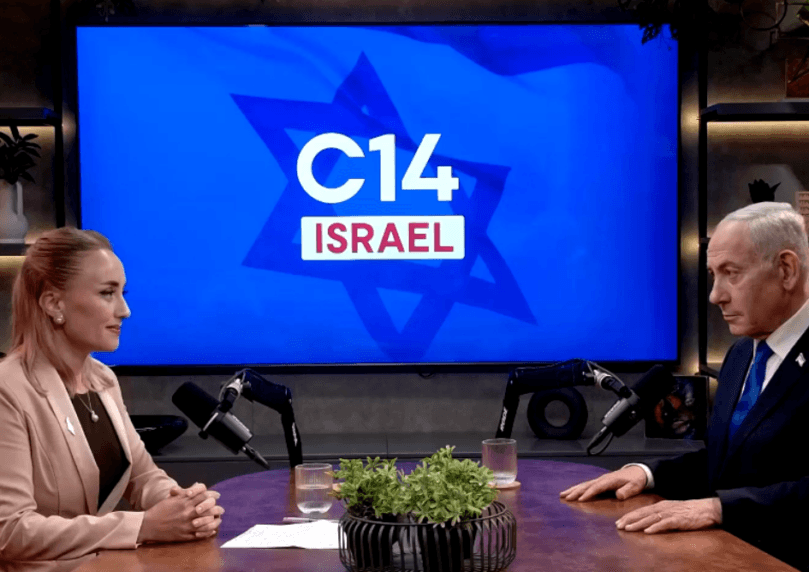
In an exclusive English-language interview with C14, the Israeli prime minister explains the updated doctrine he released hours earlier, says Israel has two years with President Trump to bring down the Iranian regime, and warns voters against the “fake right” in Israel’s rapidly approaching elections.
Prime Minister Benjamin Netanyahu told C14’s Sophia Tupolev that Israel has finished “90% of the job” against Iran and its proxies, and that the coming election will decide who completes the rest. Speaking days before Israelis head to the polls, and only hours after publishing Israel’s updated security doctrine, Netanyahu set out a vision built on defense independence and what he repeatedly called “raw power,” as well as “smart power.”
The interview opened with the Prime Minister’s reaction to President Trump’s endorsement, which Netanyahu said was less of a break with precedent than it appeared, for a surprising reason. Previous American presidents weighed in Israeli elections too, he argued, only against him. He recalled Bill Clinton calling after the 1996 election to say, “We tried everything to bring you down, Bibi, and you beat us.” Trump, by contrast, “is just telling it like it is,” Netanyahu said, because he understands that a nuclear Iran armed with intercontinental missiles would put “every American city” in range.
What changed in the doctrine
Netanyahu said he wrote a first draft of the security doctrine in 2018, and that two developments since then forced an update. The first is drones. Small, cheap, and deployable “by the thousands or tens of thousands,” they can now be flown in AI-guided swarms, which requires Israel to be ready “both offensively and defensively.”
🚨 C14 EXCLUSIVE: Has French President @EmmanuelMacron learned his lesson? Amid Muslim riots burning down France, Israeli Prime Minister @netanyahu reveals his haunting warning to Macron on October 7, 2023:
“If we don’t stop Hamas here, you’ll see them on the streets of Paris.”
@Israelipm Netanyahu tells C14’s Sophia Tupolev (@sophiatupolev) that “French people see what’s happening in the streets,” and that a political change could come to France as a result.
As the situation in France deteriorates rapidly, today, U.S. President Trump urged France to “Close the borders, fast!”
Full interview with the Israeli Prime Minister drops Tuesday, October 20th in the comments 👇
— C14 News | EN (@c14english) October 19, 2026
The second is AI and quantum computing. “Everything is run digitally, and if you have that superiority, you can paralyze a country,” he said, naming transportation, health and communications systems as targets.
Alongside the nuclear threat and ballistic missiles, those shifts led him to make independence a pillar of the doctrine. “We have to be independent as much as we can, so nobody can blackmail us,” Netanyahu said, listing arms, energy and food security.
The central principle, in his telling, is initiative. Israel will no longer wait while enemies build offensive capabilities, and it will plan around what adversaries can do. “Intentions could change overnight. Friends can become foes overnight,” he said. “We have to have more raw military power, raw intel power, and raw AI power to be able to deal with any alignment of enemies around us.”
Asked what that means in practice, Netanyahu put it in five words: “When we have to, we preempt.” He pointed to Israel’s strikes on Hezbollah and Iran as examples, but declined to say where the doctrine might be applied next when pressed by Tupolev. “I’m not going to itemize the application of these principles. I itemize the principles.” The only leader to put such a doctrine in writing before him, he noted, was David Ben-Gurion, whose version rested on defense, offense and deterrence.
Turkey and the “extreme Sunni axis”
Questioned on whether the doctrine could mean a preemptive strike on Turkey, Netanyahu said Israel does not seek confrontation. “I don’t want a confrontation with Turkey. Turkey wants a confrontation with us.”
🚨 EXCLUSIVE: We asked Prime Minister Netanyahu, what would it take for Israel to preemptively strike a country like Turkey? His answer is nuanced and detailed.
In an interview that will air later today, PM @Netanyahu elaborates on potential preemptive strikes in his updated security doctrine, in the context of Erdogan’s threats against Israel.
He notes the Jewish state has F-35s, F-16s, and extraordinarily skilled IDF soldiers, and will not bow to Ankara’s ambitions. “We’re not about to capitulate to an extreme Sunni axis, which Turkey leads.”
In an dramatic exchange with C14’s Sophia Tupolev (@sophiatupolev), Netanyahu casts doubts on Erdogan’s dreams of restoring Ottoman rule over Jerusalem, declaring: “I don’t want a confrontation with Turkey. Turkey wants a confrontation with us.”
Pressed on whether Israel’s new security doctrine could include preemptive strikes against Turkey, Netanyahu refuses to reveal future military plans, emphasizing that Israel has already demonstrated its ability to strike before its enemies accumulate the power to threaten it.
Full interview with the Israeli Prime Minister drops Tuesday, October 20th in the comments 👇
— C14 News | EN (@c14english) October 20, 2026
He accused President Recep Tayyip Erdoğan of saying Israel should be destroyed and erroneously believing that Jerusalem will belong to Turkey, and of imagining a return of the Ottoman Empire. “We’re not in the 16th century,” Netanyahu said. Having brought the Iranian-led axis close to collapse, Israel is “not about to capitulate to an extreme Sunni axis, which Turkey leads.”
He revealed that Israel had already acted militarily to stop Turkish forces moving south in Syria toward an airbase not far from Israel’s border. “I don’t seek confrontation, but I don’t shy away from it when Israel’s security needs require it,” he said, adding that Israel will keep its buffer zones “as long as we need them.”
Two years with Trump
With the U.S. midterms approaching, Netanyahu said Israel should worry about the White House changing hands in 2028. Until then, he called Trump “the greatest friend by far that Israel has ever had in the White House.” He said he has directed the Mossad, the IDF and military intelligence toward one goal. “Let’s bring down this monstrous regime, because that’s the only way that we can prevent them from trying to reconstitute the nuclear bomb program.” Trump, Netanyahu added, told him he could do it “only with me.”
Europe came in for sharper words. Netanyahu called it “an exhausted continent” with no will to fight, and said he had told Trump that America has “one fighting ally in the world, only one. That’s Israel.” He also recalled what he described as an arms embargo imposed by the Biden administration in the middle of the war, and his reply at the time: “We’ll fight with our fingernails if we have to.”
The Abraham and Isaac Accords
Netanyahu predicted that more Middle Eastern countries will join the Abraham Accords “than you think.” Asked why, he gave a one-word answer: power. Military, intelligence, economic, and technological strength have made Israel “by far the most powerful country in the Middle East,” he said, and “people come to the strong.” In Latin America, he pointed to Colombia opening an embassy in Jerusalem last week, and to Argentine President Javier Milei as signs of a “great wave” sweeping the region. He voiced hope that Flávio Bolsonaro defeats Lula da Silva in Brazil’s runoff next week, saying the Isaac Accords would then expand to “unbelievable opportunities.”
Macron, France and Jews abroad
As riots spread across France, Netanyahu revealed what he told President Emmanuel Macron on October 7. According to Netanyahu, Macron had called for an immediate ceasefire and a diplomatic solution, he said. Netanyahu recalled strongly disagreeing. “These are monsters. These are neo-Nazis,” he recalled telling him, comparing Hamas to ISIS. “If we don’t stop Hamas here, you’ll see them on the streets of Paris, and that’s exactly what is happening right now.”
🚨 EXCLUSIVE: PM Netanyahu points the finger at Russian and Qatari ops and bots for the ‘settler violence’ blood libel, calls Jews in Israel’s heartland “extraordinary” and “very brave.”
@IsraeliPM @Netanyahu tells C14’s Sophia Tupolev (@sophiatupolev) that ‘settler violence’ is a blood libel and a tool in the “8th front” disinformation war that Israel is fighting, and what he thinks it will take for Israel to overcome it.
— C14 News | EN (@c14english) October 19, 2026
Asked whether Macron has learned his lesson, Netanyahu said the French people “see what’s happening in the streets of France,” and that it could bring a change in the country’s political makeup. A right-wing government in Paris would improve relations with Israel, he predicted, “because they understand that they’re under threat.”
Netanyahu said protecting Jews outside Israel is one of the principles in Israel’s doctrine. He named attacks on Jews in France, Australia, the United States and Berlin, and said Israel often acts “with the knowledge and consent of the local governments,” without detailing how. Primary responsibility lies with those governments, he said, though the best path remains aliyah, Jewish immigration to Israel: for those who choose to come, “they’ll be welcomed here with open arms.”
The Muslim Brotherhood and the “fake right”
The Muslim Brotherhood is outlawed in Israel but, unlike in Texas, Florida and the UAE, Tupolev noted that it not been formally designated a terrorist organization. Asked why, Netanyahu said he had pushed to put the group outside the law and would “take a look” at the designation.
He then turned the question into the choice facing voters. Gadi Eisenkot, he argued, “cannot form a government” without Mansour Abbas’s Ra’am, which is affiliated with the Muslim Brotherhood, and Ahmad Tibi. The alternative is “a conservative government led by me,” built on no Palestinian state, Israel as the nation-state of the Jewish people, an assertive defense policy and a free-market, AI-driven economy.
Netanyahu named Naftali Bennett as the “classic” fake right, recalling that Bennett signed a pledge on television not to partner with the left or Ra’am, then did so after the polls closed. “Fool me once, fool me twice,” he said. Avigdor Liberman, he claimed, “talks right and always goes to the left,” and, as finance minister, transferred 53 billion shekels to Ra’am that Netanyahu alleged went to NGOs supporting Hamas. He also dismissed Ofer Winter’s party as unlikely to pass the threshold and called Yaron Zelekha’s economics “basically Meretz.”
On Judea and Samaria, Netanyahu warned that a left-wing government would push toward a Palestinian state “completely under Iran’s umbrella.” He cited Yair Golan, whom he described as Eisenkot’s likely defense minister, as wanting to drive Israelis back to the 1967 lines, and called proposals for Arab autonomy in the Galilee and Negev “the end of Israel.” Asked if he would keep blocking a Palestinian state, he replied: “I have been blocking it.”
Netanyahu said Likud’s own voter modeling, which he said scans 5 million voters, shows the blocs almost tied, with a slight edge to his side. He urged right-leaning voters not to waste ballots on small parties, citing the 1992 election that brought Oslo, and asked them to vote Likud: “machal” on the ballot.
The “settler violence” blood libel
Netanyahu called the “settler violence” narrative, increasingly cited abroad as grounds for sanctions, a blood libel against the Jewish communities of Judea and Samaria. He described residents as law-abiding and “very brave,” pointing to mothers who drive roads where terrorists have murdered Israelis and to the many young men from those communities who have fallen in battle.
He said a group of “200, 250 juvenile delinquents” is responsible for the attacks that do occur, and that he has put the Shin Bet on them. “People say it’s taking the law into your own hands. No, it’s not. It’s breaking the law with your own hands,” he said.
The larger battle, in his view, is over information. After what he called a war on seven fronts, Netanyahu described disinformation as the “eighth front,” one waged largely by bots. He blamed Qatar and Russian operations for campaigns aimed at “young American minds, young European minds,” including messaging that appeals to the woke right in the United States. Israel will counter them, he said, “with our courage, with our guts, with our brains, and with superior technology.”
“A hair’s breadth”
Netanyahu closed by describing an Israel that has gone from “the worst massacre of Jews since the Holocaust” to the verge of defeating the Iranian axis, with “opportunities here for peace, prosperity, and security that defy imagination.” Whether it gets there, he said, comes down to a single Knesset seat. “One mandate here, we win. One mandate there, they win.”