


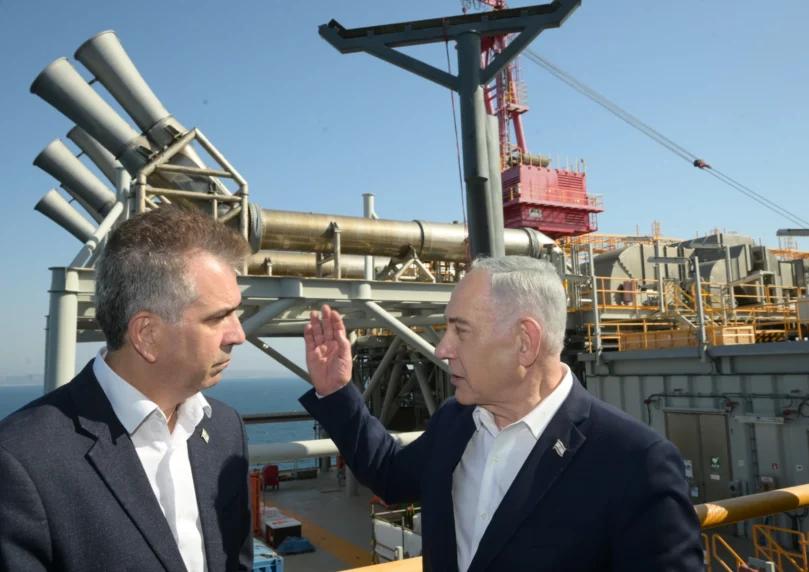

Prime Minister Benjamin Netanyahu declared that Israel’s natural gas reserves are expected to generate hundreds of billions of shekels in state revenue during a visit Thursday to the Leviathan offshore gas platform alongside Energy and Infrastructure Minister Eli Cohen.”We are extracting NIS 400 billion from the sea for the state treasury,” Netanyahu said, adding that Israel’s electricity prices are among the lowest in the developed world.
According to the Prime Minister’s Office, natural gas has already contributed approximately NIS 32 billion to state coffers, while cumulative revenues from the country’s gas and oil sector are projected to exceed NIS 350 billion. The Prime Minister’s Office credited Netanyahu’s determination and leadership with transforming Israel’s natural gas resources into a strategic national asset.

 1+
Officials also emphasized the financial benefits for Israeli households, stating that natural gas-powered electricity generation saves families thousands of shekels annually. According to Netanyahu, electricity prices in Israel are more than 20% lower than those in the European Union and other Western countries. A major component of Israel’s expanding energy industry is its natural gas export agreement with Egypt, valued at approximately NIS 112 billion. Of that amount, roughly NIS 58 billion is expected to flow into Israel’s state treasury. Netanyahu approved the $35 billion gas export agreement from the Leviathan reservoir in December 2025.
 1+
Meanwhile, Israel is pursuing additional natural gas discoveries and expanding its energy infrastructure to accommodate growing electricity demand, including the increasing power requirements of artificial intelligence data centers. During the visit, Netanyahu and Cohen also received a security briefing from the commander of the Israeli Navy’s Haifa Base on efforts to protect the offshore platform. At the beginning of the war with Iran in June 2025, the Energy Ministry ordered the temporary shutdown of the Leviathan reservoir over concerns that it could be targeted. Operations resumed approximately two weeks later, following the implementation of a ceasefire.