



Five days before Israel’s 26th Knesset election on Tuesday, October 27, Channel 14’s final NEXT DATA poll—led by pollster Shlomo Filber—shows the right-wing bloc with 62 seats, enough to form a government without relying on parties from the opposing bloc.
The poll, conducted with 7,937 adult respondents from across the population, is the last Channel 14 will publish before the election. Alongside the right-wing bloc’s advantage, Netanyahu continues to lead in questions about suitability for prime minister, while Gadi Eisenkot’s party maintains its position as the second-largest party.

 1+
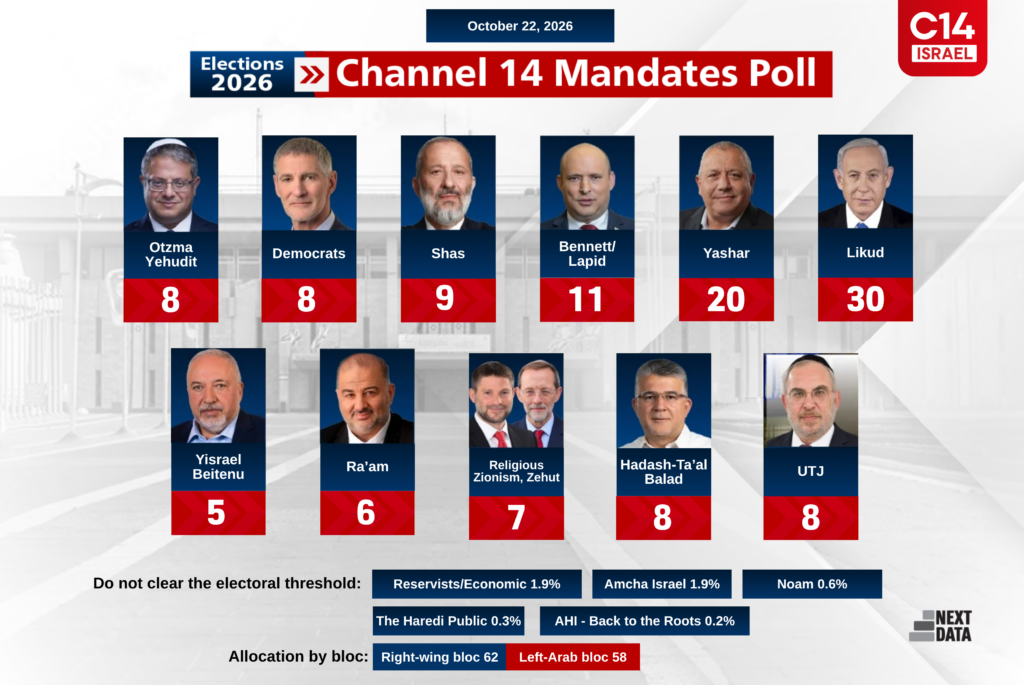
According to the poll results, Likud under Benjamin Netanyahu wins 30 seats and keeps its status as the largest party in the Knesset. The Yashar party, led by Gadi Eisenkot, stands in second place with 20 seats, unchanged from the previous poll. Bennett’s party gains a seat and rises to 11, while Shas loses a seat and drops to nine. The Democrats party, led by Yair Golan, also weakens by one seat and gets eight seats.
Otzma Yehudit, led by Itamar Ben-Gvir, holds steady with eight seats, while United Torah Judaism gains a seat and rises to eight. The Joint List also gets eight seats, and Religious Zionism-Zehut remains with seven. Ra’am led by Mansour Abbas receives six seats, while Yisrael Beiteinu led by Avigdor Lieberman stays at just five seats, unchanged from the previous poll.
While Israel Beiteinu manages to cross the electoral threshold with five seats, a string of parties remain outside the Knesset. The Reservists-Economic party receives 1.9% of the vote, down from 2.2% in the previous poll, and the Amcha Israel party drops from 1.7% to 1.5%. The Noam party remains at 0.6%, the Haredi Public party receives 0.3%, and the Ahi—Returning to Roots party gets just 0.2%.
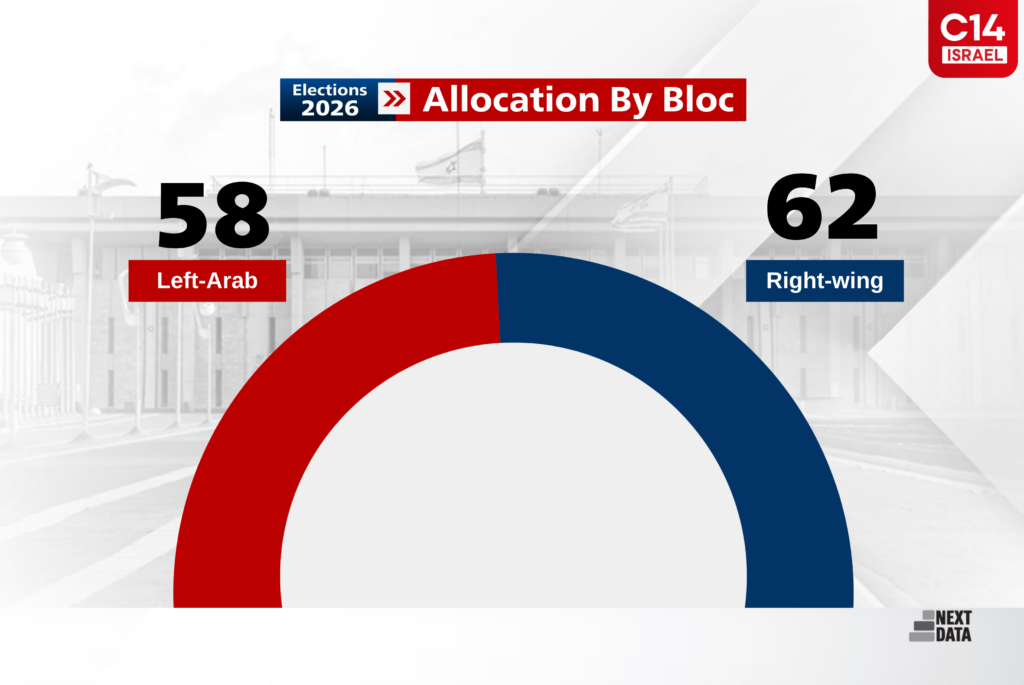
In the central test of the election campaign—forming the next government—the final poll gives the right-wing bloc 62 seats, exactly as the poll published last night showed. The left-wing bloc gets 44 seats, while the Arab parties together receive 14 seats.
The political significance of the result is that the right-wing bloc holds a majority of two seats above the threshold needed to form a government. This continues the trend Filber has shown in his polls throughout the recent period, in which the right-wing bloc repeatedly reached and even crossed the 61-seat threshold.
Meanwhile, the gap between the right-wing bloc and the left-wing bloc—which in this breakdown doesn’t include the Arab parties—stands at 18 seats. Even adding the Arab parties’ 14 seats to the left-wing bloc yields only 58 seats—four fewer than the right-wing bloc.
 1+
In the question of suitability for prime minister, Prime Minister Benjamin Netanyahu also registered a significant advantage. When respondents were asked to choose which of four figures is most suited to serve in the role, 54% chose Netanyahu, compared to 32% who chose Gadi Eisenkot. Naftali Bennett came in third with 10%, and Avigdor Lieberman fourth with just 4%. Compared to last night’s poll, Netanyahu strengthened by one percentage point, Eisenkot weakened by one point, Bennett strengthened by one point, and Lieberman lost one point.
In the direct question, where respondents were asked to choose between Netanyahu and Eisenkot only, the gap narrowed but remained in Netanyahu’s favor: 55% chose the sitting prime minister, compared to 45% who preferred the Yashar party chairman. This is an identical result to what was recorded in the previous poll.
Channel 14’s final poll was conducted today, October 22, 2026, by NEXT DATA with 7,937 adult participants from across the population. Data analysis was performed by Shlomo Filber.
This is an unusually large poll in terms of participant numbers, and it presents a picture in which Likud remains the largest party, Netanyahu leads in questions about suitability for prime minister, and the right-wing bloc heads into the election with 62 seats. On Tuesday, when the polls close, it will become clear how well Filber’s final forecast reflected the actual voting results.