



Egyptian news site Cairo24 posted a map yesterday (Thursday) on X tied to Egypt’s new high school curriculum that labels the territory northeast of Egypt as “Palestine”—with no mention of Israel. The post read: “Present in the pages of history – Palestine appears on Egypt’s political map in the new high school curriculum.” The move is striking given that Egypt has maintained peace and diplomatic relations with Israel since 1979. The Foreign Ministry needs to act and make clear this is unacceptable.

The map Cairo24 published shows countries surrounding Egypt, including Jordan and Saudi Arabia. But where Israel sits, the label reads “Palestine”—no mention of the country with which Egypt shares a border and maintains formal diplomatic relations. The Egyptian outlet’s tweet stated in Arabic: “Present in the pages of history – Palestine appears on Egypt’s political map in the new high school curriculum.” The publication comes amid Egypt’s rollout of a new high school curriculum designed to shift teaching methods from memorization to understanding, analysis, and application. Yet within this reform, a map that doesn’t mention Israel raises questions about how the region’s political reality is being presented to students.

 3+
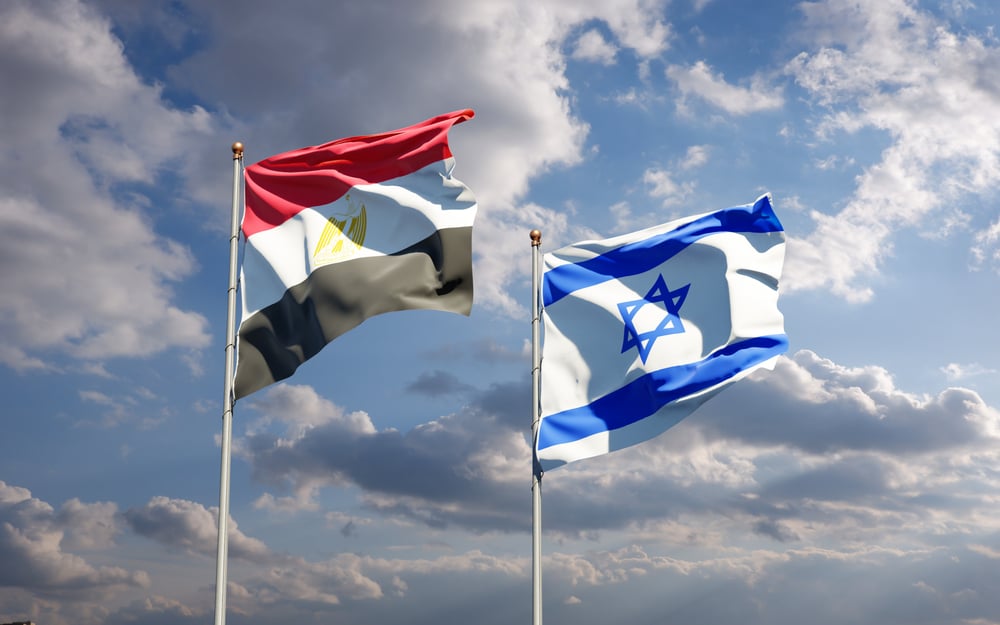
3+Egypt was the first Arab country to sign a peace agreement with Israel. The Camp David Accords were signed in September 1978, and on March 26, 1979, Israeli Prime Minister Menachem Begin and Egyptian President Anwar Sadat signed the peace treaty between the two countries, hosted by U.S. President Jimmy Carter. Since then, the countries have maintained formal diplomatic relations. Over the years they’ve also coordinated on security matters, with Egypt playing a central role mediating between Israel and actors in the Gaza Strip. Alongside political and security ties, economic relations exist as well—including natural gas supplies from Israel to Egypt. Against this backdrop, depicting the territory northeast of Egypt as “Palestine” without Israel’s name appearing on the map is particularly notable.
 3+
3+The peace treaty between Israel and Egypt includes recognition of each country’s sovereignty, territorial integrity, and political independence, alongside establishing formal relations. That said, the map’s publication alone doesn’t legally establish a “blatant violation of the Camp David Accords.” Such a determination would require examining the map’s official status, who produced it, who approved it, and the relevant treaty provisions. The claim that this represents deliberate erasure of Israel also isn’t proven by the publication alone. What can be established is that the map as presented by Cairo24 doesn’t include Israel’s name, even though Egypt officially recognizes Israel and has maintained relations with it for decades. Cairo24’s post attributes the map to the new high school curriculum, but from available information it’s unclear whether it was produced directly by Egypt’s Education Ministry, by a private company preparing educational materials, or through another entity.
 3+
3+This question carries significant weight. If this is teaching material officially approved for use in schools, it could raise policy questions about the messages being conveyed to students about Israel. If it’s a map produced by a private entity that hasn’t received government approval, the implications differ. Further clarification is needed before determining whether Egypt’s government itself decided to remove Israel from educational maps. Relations between Israel and Egypt rest on a peace agreement signed nearly five decades ago. Since then the countries have maintained formal ties, operate embassies, and cooperate on security and economic matters. Egypt also serves as a central player on issues related to the Gaza Strip, partly due to its shared border with Gaza and its regional standing.
 3+
3+Meanwhile, Israel and Egypt maintain significant energy sector ties. Israeli natural gas flows to Egypt, where it serves the domestic market and energy industry. So the published map raises a question that goes beyond graphics: How is Israel being presented to students in a country that officially recognizes it and has maintained peace with it since 1979? At this stage it’s clear that the map Cairo24 published shows “Palestine” where one would expect to find reference to Israel as well. However, to determine whether this represents official Egyptian government policy, deliberate erasure, or a violation of the peace treaty, additional information is needed about the map’s source and its status within Egypt’s education system.