


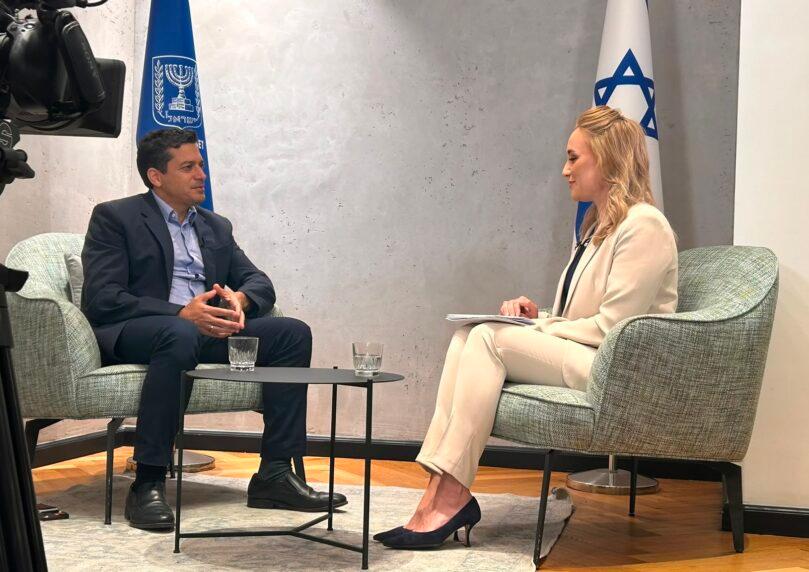

Diaspora Affairs Minister Amichai Chikli sat down with C14’s Sophia Tupolev at the Knesset this week for a wide-ranging interview from assimilation, education, sovereignty, who gets to enter the state of Israel, and beyond.
Chikli described what he sees as a crisis facing Jewish communities across Western Europe and North America. Belgium, the Netherlands, and the UK, he said, are struggling under the weight of immigration policies that brought in large numbers of unintegrated migrants. He linked this directly to what he called a rise in antisemitism, arguing that failed integration combined with what he termed “woke ideology” left European institutions unable to respond.
On the question of Jewish continuity, Chikli pointed to a different set of numbers. Outside Orthodox communities in North America, he said, fewer than five percent of Jewish children attend Jewish day schools. He called this the central threat to Jewish survival in the Diaspora, more urgent than external hostility. This week, Chikli’s ministry announced a major funding commitment tied to that concern: 100 million shekels, matched by federation partners for a total of 200 million shekels, directed toward formal Jewish education.


The funding extends the ministry’s existing Aleph Bet program, which began before the war but was constrained by budget limits during it. Early pilots of the program showed a five percent increase in day school enrollment over two years, according to Chikli, starting from a baseline he described as “around 3%.
“Nothing can replace home,” he said. “And nothing can replace school, formal education.”
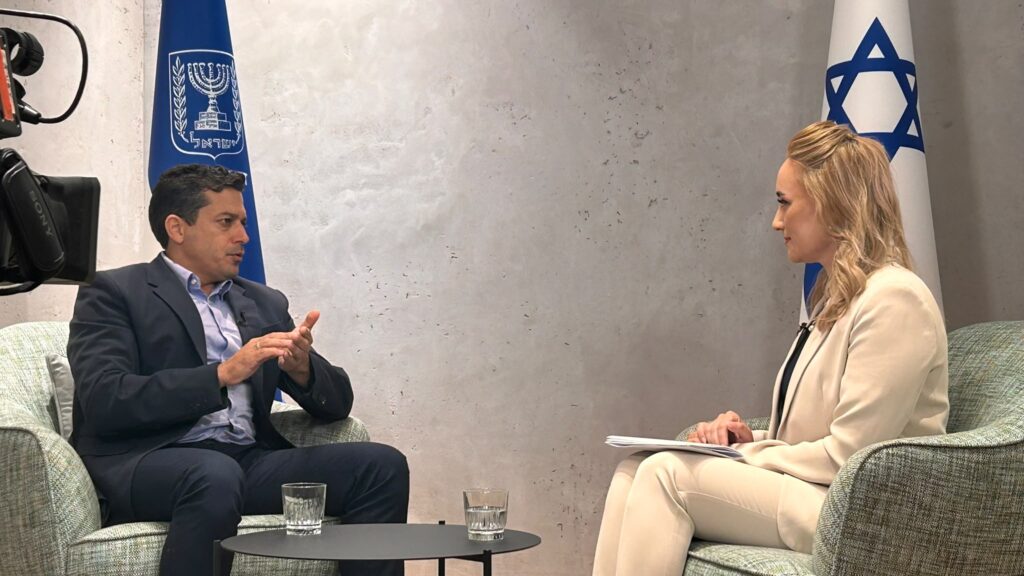
Chikli said he considers the education push, alongside the broader shift in Jewish philanthropic priorities toward this issue, among his top achievements as he approaches the end of his term. On Judea and Samaria, where Chikli argued that major Diaspora institutions have historically avoided investment for political reasons. He named Ariel, Eli, and Maale Adumim as communities he believes deserve philanthropic support, alongside archaeological sites in Shiloh, Bethel, and Hebron.
Asked directly about the term “settler,” Chikli declined to distance himself from it.
“We are proud settlers,” he said. “We’re settling new villages in our homeland. What’s wrong with that?”
Chikli elaborated on his role in Israel’s visa enforcement policy, under which he has recommended denying entry to a number of high profile figures, including relatives of Turkish President Erdogan earlier this year. Chikli described a documented set of criteria used to flag potential entrants: support for the BDS movement, accusations of genocide or ethnic cleansing against Israel, expressions of support for Hamas, or framing of the October 7th attacks as understandable “in context.”
Asked if this is a lifetime ban, Chikli responded, “If they will make teshuva,” he said, using the Hebrew term for repentance, “maybe we’ll change our decision.”
Chikli also addressed his outreach to right wing European parties, including France’s National Rally, Spain’s Vox, and Hungary’s Fidesz, several of which carry documented histories of antisemitism within their ranks. He argued that leadership within these parties has shifted meaningfully in recent years, pointing to Marine Le Pen’s public break from her father Jean-Marie Le Pen and her participation in a march with the Jewish community following October 7th. He acknowledged that Austria’s Freedom Party carries a more difficult history but said the relationship has moved toward requiring formal steps, including adoption of the IHRA definition of antisemitism, before further cooperation proceeds.
The interview closed on the subject of sovereignty. I noted that Prime Minister Netanyahu has recently reiterated ruling out a two state framework, while Israel takes no formal stance against Sharia law. Chikli said he’d like to see the Muslim Brotherhood banned, including Ra’am, Mansour Abbas’ party in Israel.
Pressed on why the Muslim Brotherhood’s political arm remains active in Israel, including Raed Salah’s banned northern branch of the Islamic Movement and the legally operating Ra’am party, Chikli offered a direct answer.
“Because of the Supreme Court,” he said. “Because we’re not a full democracy.”