


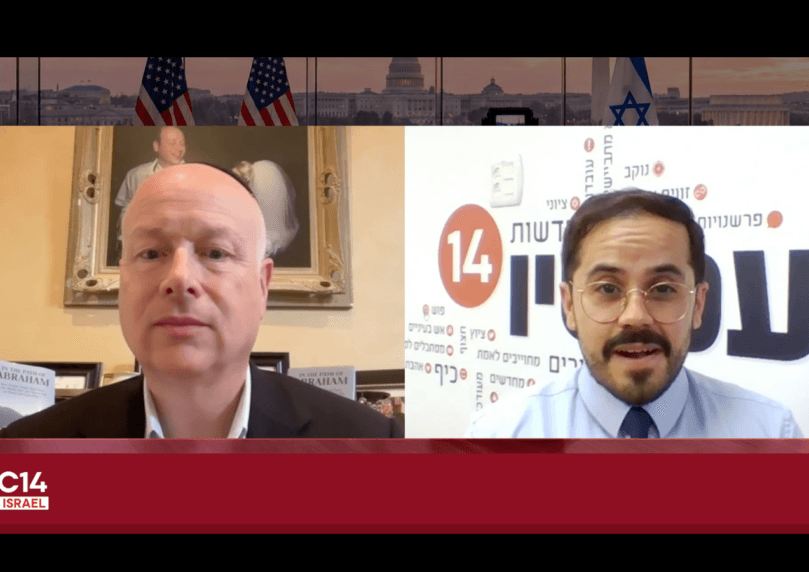

Watch this interview on C14 English.
President Trump landed in Beijing this week with a clear message: he does not need Xi Jinping’s help on Iran. The Iranian regime is being squeezed from every direction, the Gulf has stepped into the fight, and the man who helped engineer the Abraham Accords says the second Trump term has already exceeded what the first one dared to imagine.
Jason Greenblatt worked alongside Donald Trump for 23 years, 20 in the private sector and three inside the White House. He helped negotiate the original Abraham Accords.
“The president has been clear that he doesn’t need China’s help,” Greenblatt tells Yaniv. “Trade is primary, the primary focus of what’s going on. Obviously, they’ll speak about Taiwan. They certainly will speak about Iran. There’s a lot of conjecture whether or not President Trump will ask Xi Jinping for assistance on Iran. It’ll come up in the discussion, but I think President Trump is very confident he does not need China’s help. If anything, China probably needs the Strait of Hormuz open much more than the United States.”
The interview airs as Prime Minister Netanyahu has confirmed he visited the UAE during the war, and as the UAE, Saudi Arabia, and Kuwait have each acknowledged, in one form or another, that they joined the strikes during Operation Epic Fury. Greenblatt, the architect of the Accords, says the Gulf’s involvement is rational and welcome.
“It’s in their best interest to join this fight in whatever capacity they feel comfortable. This war is not just America’s alone. It’s certainly not just Israel’s alone. These countries, whether they signed the Abraham Accords or I’d like to say have not yet signed the Abraham Accords, are suffering from the same threat of Iran, maybe at a different level. Iran hasn’t said they want to destroy them or kill them or annihilate them, but they certainly want to do a lot of damage to them.”
On the UAE specifically, Greenblatt is effusive. The Emirates pulled out of OPEC and have positioned themselves as the regional leader of the anti-Iran bloc. “The UAE has been a leader, a strong leader in these kinds of decisions. I frankly think they don’t get enough credit for the courageous decision that they made to join the Abraham Accords and not just to join the Abraham Accords, but sticking with it from October 7th, from the horrible news of October 7th, from the aftermath of October 7th through this current war. I think they deserve a lot of credit and they’re a leader and we should respect them for it.”
The Trump that Israelis worried about in 2016, the deal guy who knew nothing about Israel, is gone. In his place is a president whose second term has reshaped the Middle East. Greenblatt says the conviction was always there. “He made no secret about what he thought about the Iranian regime, certainly the JCPOA. He made promises to tear up the JCPOA, the Iran deal that was done by President Obama. He did that. And I don’t think people really imagined what happened last summer with respect to the attacks on Iran and certainly now what’s happening. I think we’re roughly in day 75.”
Why now and not in the first term? Greenblatt’s answer points to intelligence. “What probably happened is the intelligence that was being shared with him, both by our own intelligence agencies, by the Israeli intelligence agencies, perhaps other intelligence agencies, showed President Trump that the danger really is there, that it’s gotten stronger and stronger.” Iran, he says, was trying to make its nuclear program, missile program, and drone program “almost impenetrable.” If the United States and Israel had not acted now, it would have become “nearly impossible, or certainly far more difficult, far more costly in terms of lives and money to do it.”
Greenblatt gently pushes back on Netanyahu’s plan to wean Israel off the $3.8 billion in annual US military aid. The goal is admirable, he says, but the math is brutal. “If Israel is actually capable of doing it, both from a technology and people, human capital perspective and financial perspective, I think trying to achieve that is great. However, and I think we see this so clearly from this war, the costs to do this are so enormous. I don’t know that Israel has the capacity to do it. Israeli citizens are taxed at an unusually high number. Israelis certainly pay a lot of high taxes and part of that is because they have to spend so much money on national defense.”
He continues: “Everybody’s running out of interceptors. Everybody’s running out of weapons. Wars like this will happen again. And I think keeping the United States being able to help Israel both financially and with equipment, even though to some degree it’s also a two-way street, Israel gives the United States a lot as well. I’d like to see that sustained for a long time.”
Asked why the case for Israel has become so hard to sell to American voters, Greenblatt does not flinch. “Part of it is anti-Semitism. Part of it is the age old “We hate Israel.” Part of it is people who love Palestinians who want to see what they call, and it’s a term I hate to use, a so-called two state solution. Nobody really even knows what that is. Part of it is people just look inward and think that we should be spending money only on ourselves.” The deeper driver, he says, is “hatred of Trump and anything he accomplishes. People completely not understanding. They really don’t understand war. They don’t understand strength. They don’t understand power. They don’t understand threat. They don’t understand danger. They don’t understand the neighborhood of the Middle East.”
On where this goes next, Greenblatt is sober but not pessimistic. He does not believe the Iranian regime in its current form will sign the kind of deal Washington and Jerusalem need. But he has spent two decades watching Donald Trump close the impossible. “He is somehow a guy who pulls many rabbits out of a hat. So I don’t bet against him. I just find it hard to believe that the deal that he needs and wants is going to be achievable. Therefore, I think we’re likely to go back to some sort of military escalation, maybe not a full war, but targeted strikes to put continued pressure on the Iranian regime, including, of course, the economic pressure with the double blockade.”
The region, Greenblatt says, is watching. Saudi Arabia, Qatar, and others are seeing what an Israel-led, US-backed war machine can actually do. The road to a wider peace runs through that recognition. “If there’s ever a president, a leader who might be able to break through all of it, it would be President Trump.”