



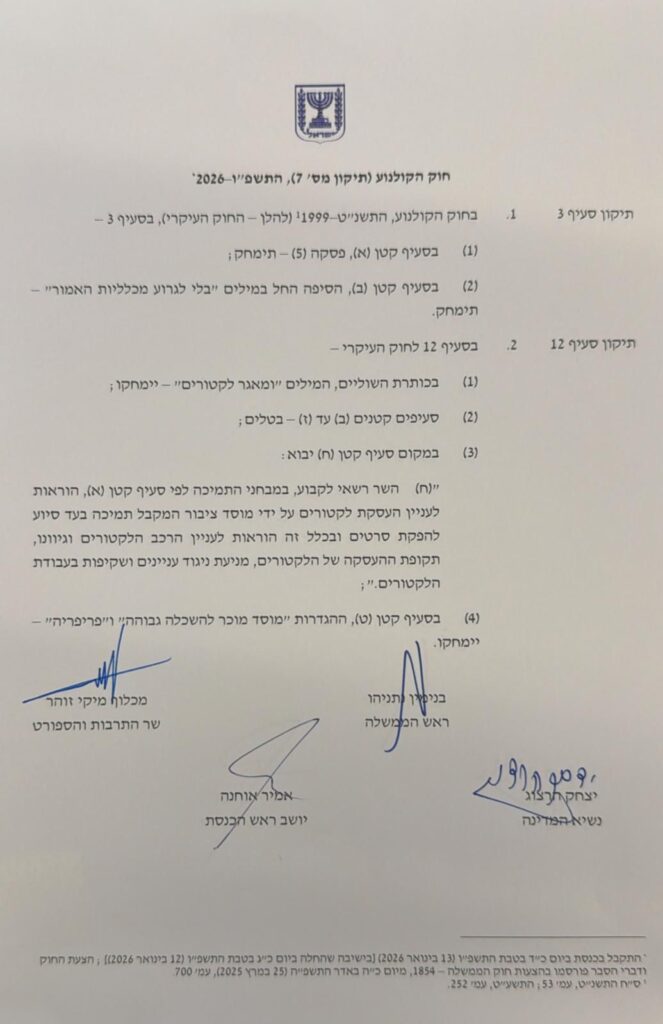
Prime Minister Benjamin Netanyahu officially signed legislation today (Monday) abolishing the “Readers’ Pool law” a central component of Culture and Sports Minister Miki Zohar’s cinema reform. The move, approved by the Knesset in January, is designed to bring structural change to Israel’s film industry—and effectively end the control of left-wing figures over the country’s cinema sector.

The “cinema reform” fundamentally changes how films are funded in Israel, giving clear priority to works that enjoy broad public appeal and reflect values accepted by most of the Israeli public. Minister Zohar made clear the goal is to end a situation where the state funds films that portray IDF soldiers in a negative light—and redirect resources to works that will strengthen local culture and not weaken the country’s image.
Film industry figures, however, have argued that the minister’s steps constitute an attempt at a political takeover of the arts and censorship of critical voices. According to critics, The reform’s new criteria and the halt to funding for the Israeli Film Academy awards ceremony are a severe blow to creative independence and the standing of Israeli cinema in the world.
The confrontation between the film industry and Culture and Sports Minister Miki Zohar escalated when a group of key industry figures sent an urgent letter about two months ago to Attorney General Gali Baharav-Miara, demanding from her to intervene and order the cancellation of the minister’s decision to stop public funding for the Ophir Awards ceremony. In their letter, they warned that this was a draconian step harming freedom of expression, and threatened that if the decision is not immediately reversed, they will petition the High Court against the move and against central provisions in the cinema reform the minister is advancing.
Zohar’s decision to advance the move came after what he described as a “pro-‘Palestinian'” film won at the last Israeli Acadmey Awards ceremony—which for him was the last straw. The minister sharply attacked the veteran institution and argued that in recent years the ceremony has become a stage that sanctifies foreign narratives disconnected from the people, including statements against the State of Israel and IDF soldiers. According to Zohar, the ceremony serves as a tool for political subversion by a narrow group, and therefore there is no justification for continuing to fund it with public money while it “spits in the face” of citizens and soldiers.