


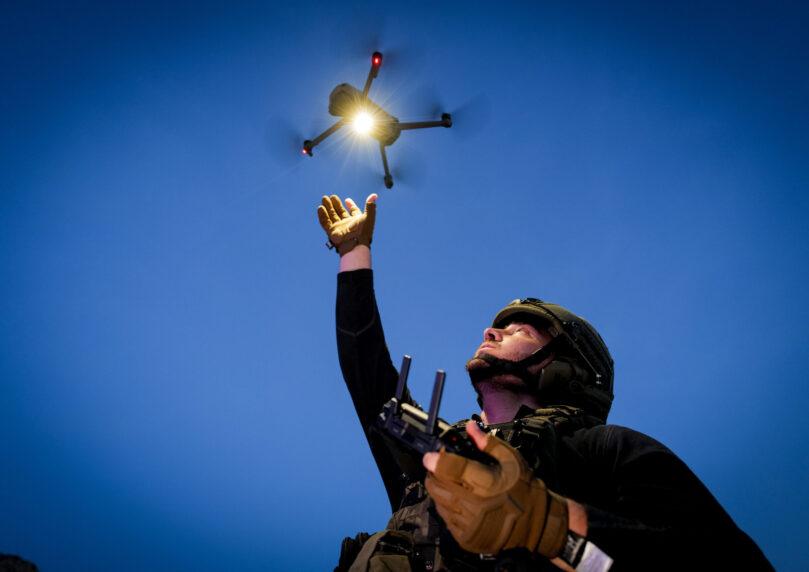

Hezbollah’s suicide drones have become one of the most troubling threats facing IDF forces operating in Lebanon and northern Israeli communities in recent weeks. After a brutal day in which one soldier was killed and 17 others wounded by fiber-optic drones, tough questions emerged about the IDF’s readiness for this known threat.
In an exclusive interview with C14, Shmulik Shof, CEO of Oss Target and an expert in weapons and technology integration, explains that the answer to the threat isn’t just in tomorrow’s laser systems, but in a combination of creative solutions, focused training, and existing technology the IDF hasn’t fully harnessed.
The Enemy Went Low-Tech: Why Fiber-Optic Drones Are So Hard to Stop
Shof, who brings extensive experience in small arms and robotic firing system integration, explains the threat isn’t new: “This threat has existed for a while, it’s not something new. I know systems that have been dealing with this for eight years already.”
“What’s happening in the current situation is that we’ve essentially gone down a level,” Shof says. “The enemy took a very simple system, connected fiber-optic cable to it, and disconnected all wireless or GPS means. It’s an event that resembles launching a mortar with flat navigation. They fly the drone at low altitude to create a minimal signature and get as close as possible to the force. Because of the physical connection (the wire), you can’t jam them with standard electronic measures.”
The Three-Layer Plan for Victory: Training, Concealment, and Active Defense
Shof proposes a work model divided into three layers, combining the security world with civilian creativity:
Layer 1: Training Fighters with the “Clay Pigeon” Method
The main problem for ground troops is the difficulty hitting small, fast targets in the vertical dimension. Shof proposes a solution from the civilian hunting world: “One of the simplest means to train a force is a clay pigeon shooting range (Trapshooting). The characteristics of a clay pigeon thrown in the air and a suicide drone are very similar. It’s a cheap civilian installation, simple to move on a trailer, that can be positioned at any base or force concentration point. The fighters practice shooting at high angles, learn what the target looks like to the eye, and acquire ‘muscle memory’ of hitting. It gives them tremendous confidence that they can bring down the threat.”
At the same time, he recommends attaching hunting shotguns (“12 Gauge”) to forces: “The Ukrainians are already using this. At a range of 30-40 meters, when the drone starts its death dive, a shotgun creates a cloud of pellets that simply tears apart the propellers and brings it down. It’s a cheap tool, simple to operate, that’s also good for room clearing.”
Layer 2: “Blinding the Attacker” – Smoke Concealment from the Movie Making Business
Here Shof brings his unique expertise: “In film we use smoke concealment means that are cheap, easy to operate, and environmentally friendly. Similar means can be developed for forces in the field to conceal their activity. The fiber-optic drone is based on direct line of sight by the operator. If the force creates a smoke cloud around itself, the operator loses the target. It’s a ‘dumb’ solution but incredibly effective that neutralizes the attacker’s navigation capability.”
Layer 3: The Operational and Technological Response
Shof noted the report by our military analyst Noam Amir that the IDF is working to expand the physical and tactical protection of forces in addition to active air-based solutions. The emerging plan is divided into three time frames, starting with immediate response in the field, through a solution in the coming weeks, to introducing advanced energy-based weapon systems.
Passive Defense: Deploying physical protective nets around facilities and outposts, which is already happening in the field through rapid improvisation by fighters.
Kinetic Interception: Using “Smash” sights (Smart Shooter) mounted on small arms that enable locking and precise hits on drones.
Aerial Interception: In the coming weeks, “drones against drones” will be introduced – autonomous tools that collide with enemy drones or neutralize them electronically.
Energy Weapons: In the longer term, the goal is to introduce laser systems for interception at zero cost.
The Barrier: “You Can’t Develop Weapons in Dad’s Garage”
Shof points an accusing finger at the bureaucracy blocking Israeli creativity: “There are brilliant guys who get discharged from the army with cheap and fast solutions, but they have nowhere to test them. To develop weapons you need a military range, regulation, and insurance. The defense establishment must give this ‘push’ to creativity, allocate areas, and let people who know the field work 24/7. We saw in the war that solutions that came from civilian industries are serving the fighters successfully to this day.”