


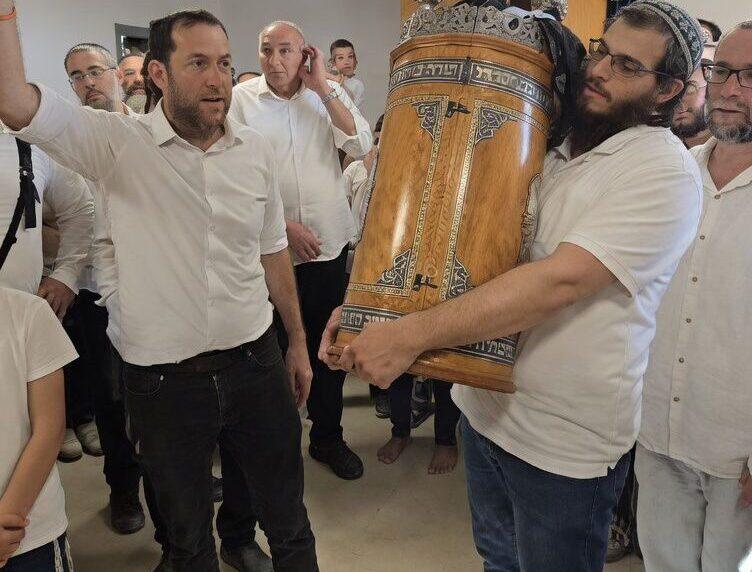

Twenty years after the expulsion, and just days since residents returned: emotional footage from Sa-Nur shows celebrations held Thursday as the Torah scroll donated by Shaul Halfon Z”L some 20 years ago was returned to the community. The scroll was brought back by his son, Shlomo Halfon, and the event was attended by Samaria Regional Council head Yossi Dagan and Finance Minister Bezalel Smotrich, who said: “Now we are erasing the injustice of the expulsion.”
Shlomo Halfon, who returned his father’s Torah scroll to the community, described the emotional full circle: “I was expelled from Sa-Nur as a 20-year-old boy and returned with my wife, my six children, and the holy Torah scroll I left with—which was so important to my father—to the place it was so hard for us to leave.”
He recounted the days before the expulsion and his father’s efforts: “Before the expulsion, my father wrote a Torah scroll for Sa-Nur, and then worked hard to raise funds and build a new synagogue in Sa-Nur named after his friend, former IDF Chief of Staff Raful, in place of the mosque where they had prayed all those years. He managed to build the synagogue with Jewish labor—right up until the eve of the expulsion, the building stood with a roof and doors. On the last Shabbat evening, we held a Torah dedication ceremony in the building, from which we were ultimately expelled. As part of the expulsion, the synagogue was buried and still stands in its place under piles of dirt.”
He described the Torah scroll’s journey back to the community: “The Torah scroll, the ark, and the curtain were in my parents’ home for almost 19 years. About a year and a half ago, Bnei Chayil Yeshiva was looking for a Torah scroll, and my wife encouraged me to ask my mother whether she would be willing to lend it to them. At first, I hesitated, but my wife said, ‘The moment the Torah scroll leaves the house, it will return to Sa-Nur, and we will all return to Sa-Nur.’ My mother was convinced, and a few weeks after we brought the scroll to Bnei Chayil, it was announced that the return to Sa-Nur was beginning.”
According to him, the peak moment came on the last Independence Day, in a split-second decision: “When we arrived to visit Sa-Nur at noon, we discovered the scroll hadn’t yet been brought up, and without thinking twice, my wife and I understood we were going to bring the scroll. We quickly went back down to Kedumim, gathered our children from the house, and set out. It was the most spontaneous and holiest Torah dedication ceremony there could be. When I see Sa-Nur with the core group families, I feel like a dead person has come back to life. May we merit to soon return to all the communities we were uprooted from in the Gaza Strip, Gush Katif, and all of northern Samaria.”
Finance Minister Bezalel Smotrich said at the event that this represents “erasing the injustice and terrible folly of the expulsion from northern Samaria, and now we have returned to Homesh and Sa-Nur—this time forever.”
Samaria Regional Council head Yossi Dagan shared emotionally: “We saw through tears this righteous man, Shaul Halfon Z”L, taking this Torah scroll out of the Sa-Nur synagogue for the expulsion, surrounded by police and soldiers. And today we merit together to return the scroll to its place. Shaul is now rejoicing above in the heavenly court, and G-d comes and says to him: ‘See my son, there is reward for your work.’ Shlomo, Shaul’s son, is now placing the Torah scroll in the ark in the community, which Shaul also donated.”
Shaul Halfon Z”L fought in Unit 101 under Ariel Sharon’s command and parachuted in Sinai under the command of Rafael (Raful) Eitan—he named the synagogue he built after Raful. Uniquely, the synagogue was the only structure not demolished in the Gush Katif and northern Samaria expulsion, but rather buried under tons of dirt. For over 20 years after Shaul’s death, the Torah scroll waited in Nofim, and later in his son Shlomo’s home in Kedumim.