


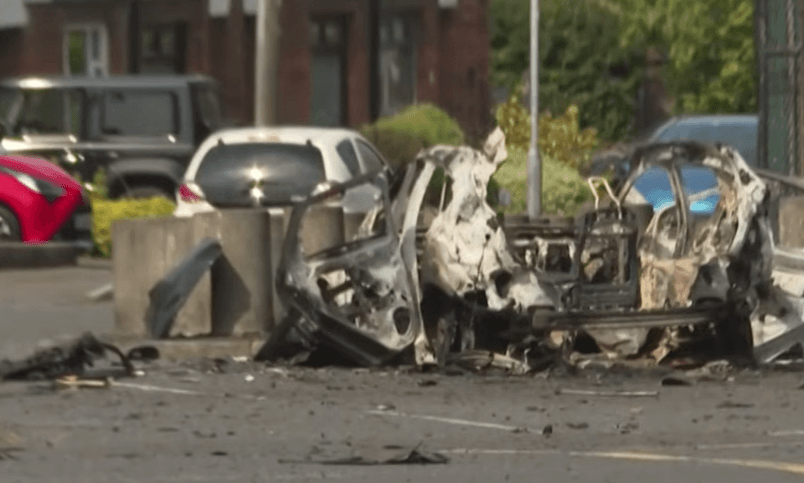

The terror group “New IRA” claimed responsibility Tuesday for a car bomb explosion near a police station in Belfast, Northern Ireland, and warned of more attacks to come. The device detonated outside the station in the Dunmurry neighborhood in a stated attempt to kill officers as they left the facility.
Local police stepped up patrols following the group’s threats to target officers at their private homes. As part of the bombing investigation, a 66-year-old man was arrested under terrorism laws. In a statement attributed to the organization’s leadership, the group made clear that anyone cooperating with security forces would be dealt with harshly.
The connection between Irish separatists and the axis of evil is no coincidence and rests on alarming intelligence reports. A 2020 report in The Times revealed disturbing MI5 intelligence pointing to logistical and operational ties between the New IRA and both Hezbollah and Iran’s Revolutionary Guards.
Concerns about external support in weapons and funding intensified after group members signed a condolence book following the U.S. killing of Iranian General Qassem Soleimani. These gestures point to a deep network of connections that extends beyond the Middle East and reaches into the heart of Europe.
Andrew Badger, a former intelligence officer at the U.S. Defense Department, told the Daily Mail that this connection is part of transforming the “axis of resistance” into a global operational network. The move unites Russia, Iran, China and North Korea together with non-state organizations into a shared logistical and trade network.
According to Badger, this represents the maturation of a hybrid warfare model led by Russia and Iran. Within this model, adversaries of the Western order share terror tactics, methods and technologies regardless of geographic location or local ideology.
The real challenge for security forces lies in these groups’ ability to learn from each other rapidly. A tactic tested on one battlefield can reach a remote terror cell within months.
Training of a Lebanese Shiite militia for an Irish republican faction would have seemed fantastical in the past, but today it aligns with a broad supply line that includes Russian sabotage cells in Europe and Iranian assassination plots on British and American soil. These actors are joining forces in logistics, weapons and financing while exploiting local protest movements in target countries.
The European Union has already declared the Revolutionary Guards a terrorist organization and committed to swift implementation of sanctions. In Britain, by contrast, criticism has been voiced about foot-dragging on the issue. The British government has not yet completed the formal designation of the IRGC as a terrorist organization.
This comes despite evidence of Iran-linked centers within the country spreading extremist content. The Dunmurry attack serves as a painful reminder that resistance to the Good Friday Agreement and the aspiration to end British rule have become tools serving the ayatollahs’ regime as part of the global campaign against the West.